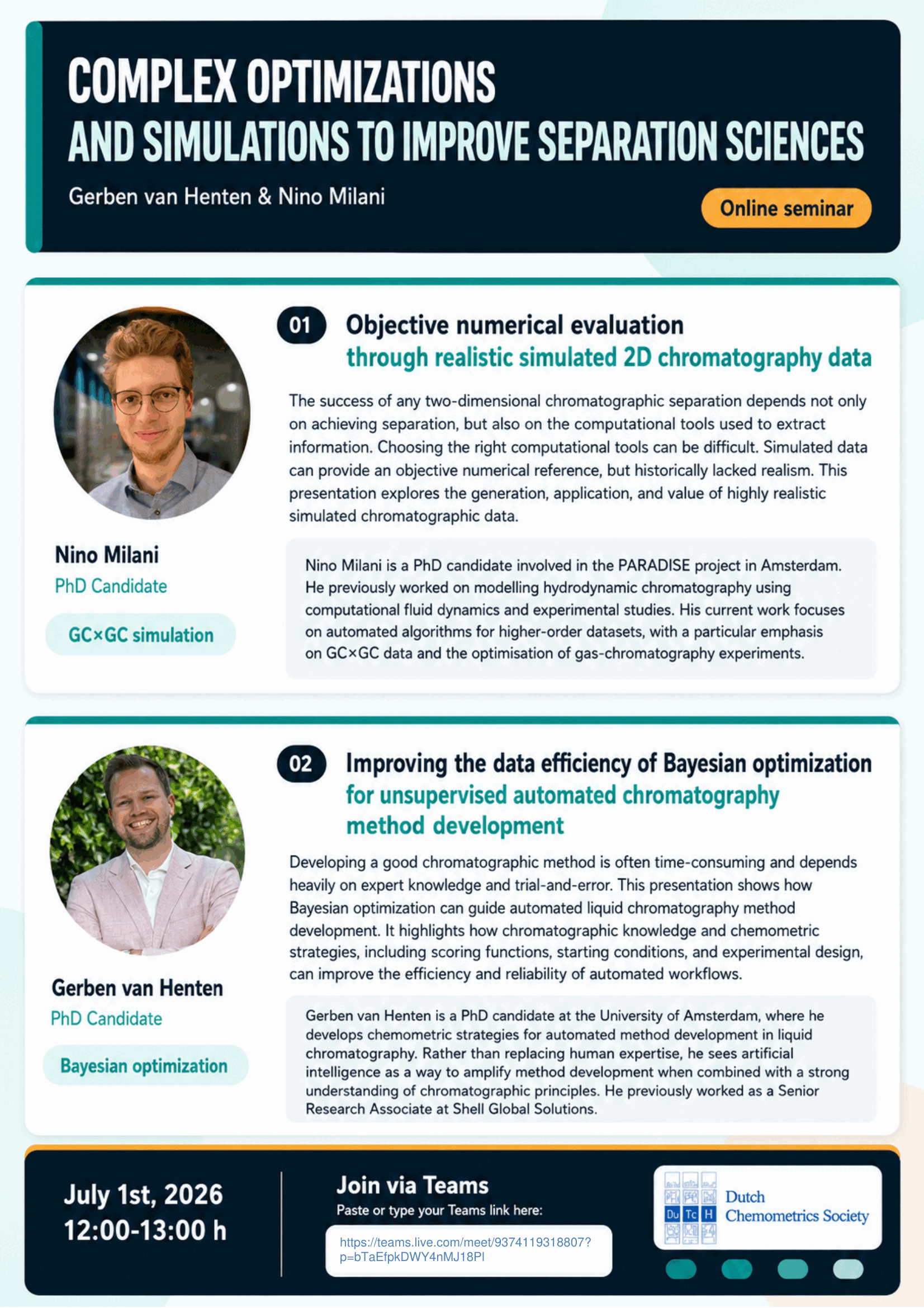
DCS Online Webinar 2: Complex Optimizations and Simulations to Improve Separation Sciences
The Dutch Chemometrics Society is pleased to invite you to its next online seminar: “Complex Optimizations and Simulations to Improve Separation Sciences”, taking place on Wednesday, 1 July 2026, from 12:00 to 13:00 h.
This session will feature two PhD candidates working at the interface of chemometrics, chromatography, simulation, and automated method development: Nino Milani and Gerben van Henten. Both are conducting their PhD research within the Chemometrics and Advanced Separations Technology (CAST) group under the supervision of dr. Bob Pirok, where they contribute to the development of advanced computational and chemometric strategies for separation science. Together, their presentations will highlight how simulation, optimization, and data-driven modelling can support more objective, efficient, and reliable workflows in modern chromatography.
Nino Milani will open the seminar with his presentation, “Objective numerical evaluation through realistic simulated 2D chromatography data”. Two-dimensional chromatographic separations generate rich and complex data, but evaluating such data objectively remains challenging. Nino will discuss how highly realistic simulated chromatography data can serve as a numerical reference for method evaluation and algorithm development. His work focuses particularly on automated approaches for higher-order datasets, with an emphasis on GC×GC data and the optimization of gas-chromatography experiments.
The second presentation will be given by Gerben van Henten and is titled “Improving the data efficiency of Bayesian optimization for unsupervised automated chromatography method development”. Developing a robust chromatographic method is often time-consuming and depends strongly on expert knowledge, experimental design, and trial-and-error. Gerben will show how Bayesian optimization can guide automated liquid chromatography method development, and how chemometric strategies such as scoring functions, starting conditions, and experimental design choices can improve both the efficiency and reliability of automated workflows.
This seminar will be of interest to researchers, students, and practitioners working in chemometrics, chromatography, analytical chemistry, method development, and laboratory automation. It will also provide insight into how artificial intelligence, simulation, and chemometric modelling can complement expert knowledge in separation sciences.
The seminar will take place online via Teams.
DCS seminar 2: Complex Optimizations And Simulations To Improve Separation Sciences
Wednesday, 1 July 2026
12:00 - 13:00 (UTC +1)
Meeting link: DCS seminar 2: Complex Optimizations And Simulations To Improve Separation Sciences | Microsoft Teams | Meetup-Join
______________________________________________________________________________________________________________________